


Date added: 2026-11-06
Deliverable and milestone for WP1 achieved!

We are pleased to report a significant achievement in our project! Our best-performing SiOC/C matrix material has demonstrated a reversible capacity of 846 mAh g⁻¹ at the low current of 20 mA g-1 (Figure 1 ) exceeding the target established in our original project proposal (600 mAh g-1) by 40%. This result represents an important milestone in our research and highlights the promising potential of the materials we are developing.
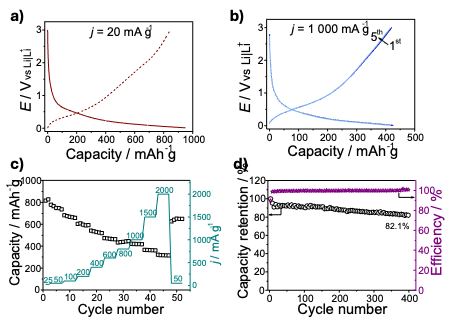
Figure 1. Charge/discharge curves recorded at a) 20 mA g-1 (second cycle) and b) 1000 mA g-1 (five cycles) for the silicon oxycarbide electrode. C) Capacity values recorded at various current densities and d) stability of the capacity recorded at 400 mA g-1 preceded by two formation cycles at 20 mA g-1 (not shown for better clarity). All measurements were recorded half-cell configuration.
Furthermore, our material demonstrates excellent rate capability (Figure 1 c), retaining a reversible capacity of 420 mAh g⁻¹ at a current density of 1 A g⁻¹ (Figure 1 b). Notably, this corresponds to a charging time of less than 26 minutes, while still delivering a higher specific capacity than a conventional graphite anode, which typically provides only 200–250 mAh g⁻¹ under comparable high-rate conditions. This marks another important achievement in our project, demonstrating the material's potential for fast-charging applications!
We have also successfully achieved another key project target: long-term cycling stability of the SiOC-based anode material (Figure 1 d). Following two formation cycles at 20 mA g⁻¹, the electrode cycled for 400 cycles at 400 mA g-1 maintains 82% of its initial capacity, meeting and exceeding our original target of 80% capacity retention over 400 cycles. This further confirms the promising electrochemical performance and durability of our developed material.
Our work continues, and we remain committed to achieving the remaining milestones outlined in our project objectives. We are currently focusing on incorporating silicon and tin nanoparticles into our established SiOC matrices, as well as investigating pre-lithiation strategies. These ongoing efforts aim to further enhance the electrochemical performance of our materials and bring us closer to achieving the remaining project goals. We look forward to sharing more exciting results and milestones with you soon. Stay tuned for further updates!